
Built by us · not a demo
The system we built to run our own business
A complete business platform — CRM, quoting, jobs, point of sale, invoicing, inventory, franchise management and a customer portal. It's live, our own work is moving onto it, and it's the most honest answer we can give to "can you actually build something like this?"
- Franchise-scoped
- Changes logged
- GST handled
- Built in-house
The problem
Six tools, one job, and nothing reconciling
Running a service business is one continuous thread. Someone enquires, you quote, you schedule, you do the work, you invoice, you chase the payment. Most small businesses run each step in a different tool, and the thread breaks at every handover.
- A quote written in one tool, the job in a calendar, the invoice in an accounting package.
- The same customer typed in three times, spelled three different ways.
- No single place that answers “what is outstanding right now?” without adding it up by hand.
- Nothing that survives the person who happens to remember how it all fits together.
Integrating six products would have joined the tools together. It would not have made the thread a thing the software actually understood.
The approach
Model the thread once, then build views onto it
One record moves through the whole business. Every screen in the platform is a view of where it currently sits.
- Lead
- Customer
- Quote
- Job
- Invoice
- Payment
-
One record, many views
A quote becomes a job becomes an invoice. The same record moves through the business and every screen is a view onto it, so nothing is retyped at a handover.
-
Boring on purpose
A conventional stack, chosen because somebody has to maintain it for years. Nothing exotic, nothing that needs a specialist to keep the lights on.
-
Audited from the start
Every change is recorded from day one rather than added later. A system that holds money has to be able to answer who changed this, and when.
What was built
The actual product, on a demo dataset
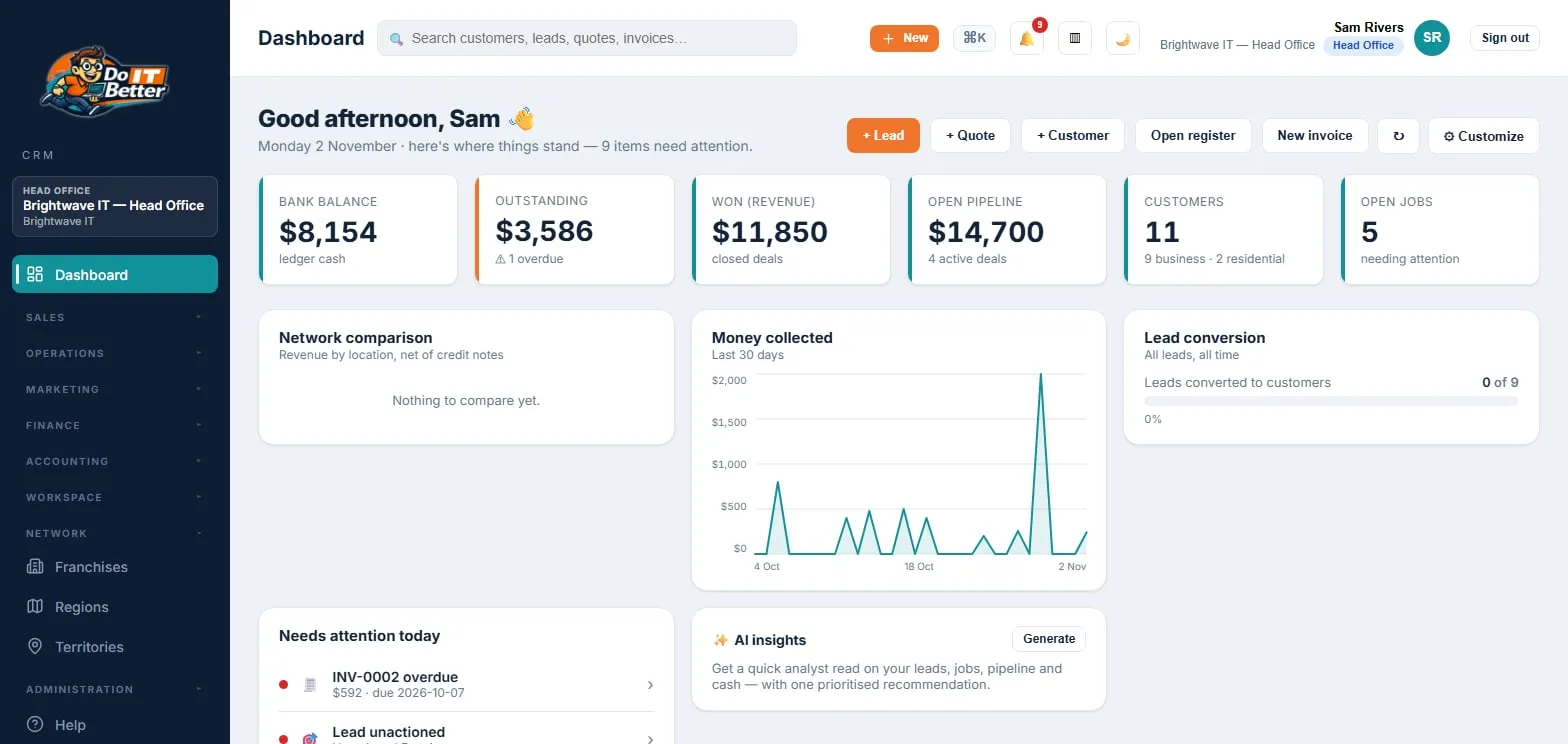
Real captures, not mock-ups. Every customer, quote and figure on this page is invented, so nothing here is a real client's information.
Dashboard preview
-
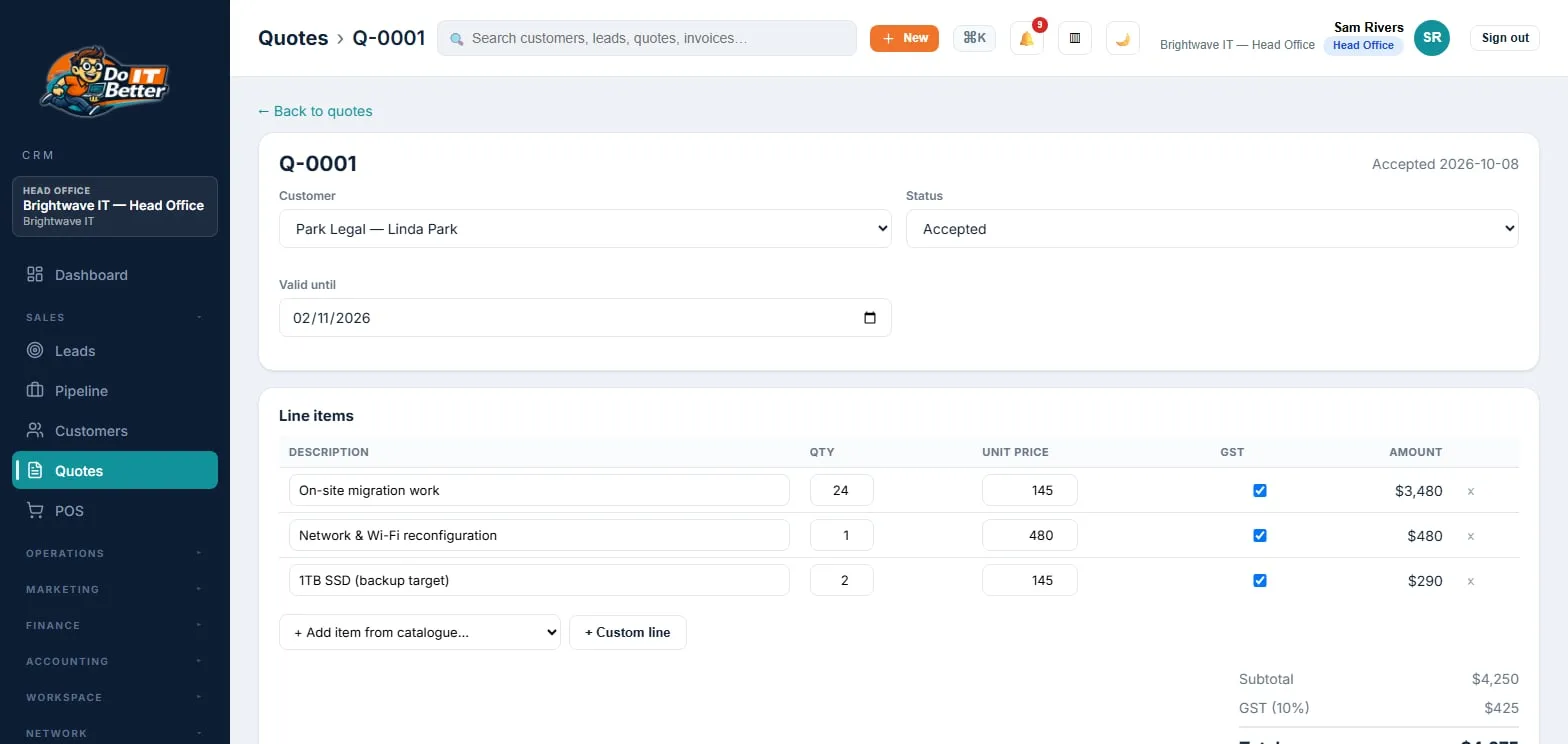
Quoting
Line items, GST calculated properly, and a quote a client can accept online.
-
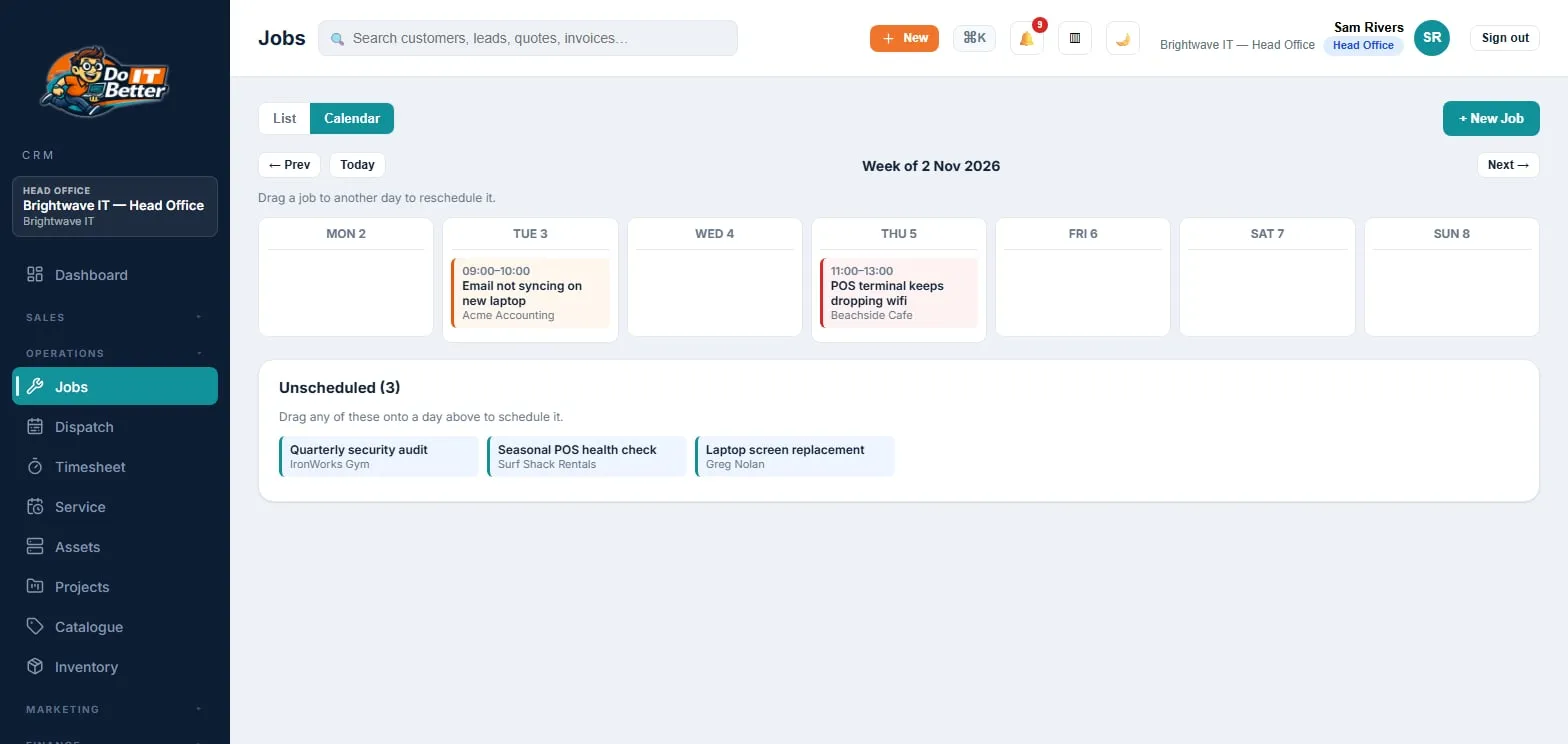
Jobs & scheduling
The week at a glance, drag to reschedule, with anything unscheduled kept visible.
-
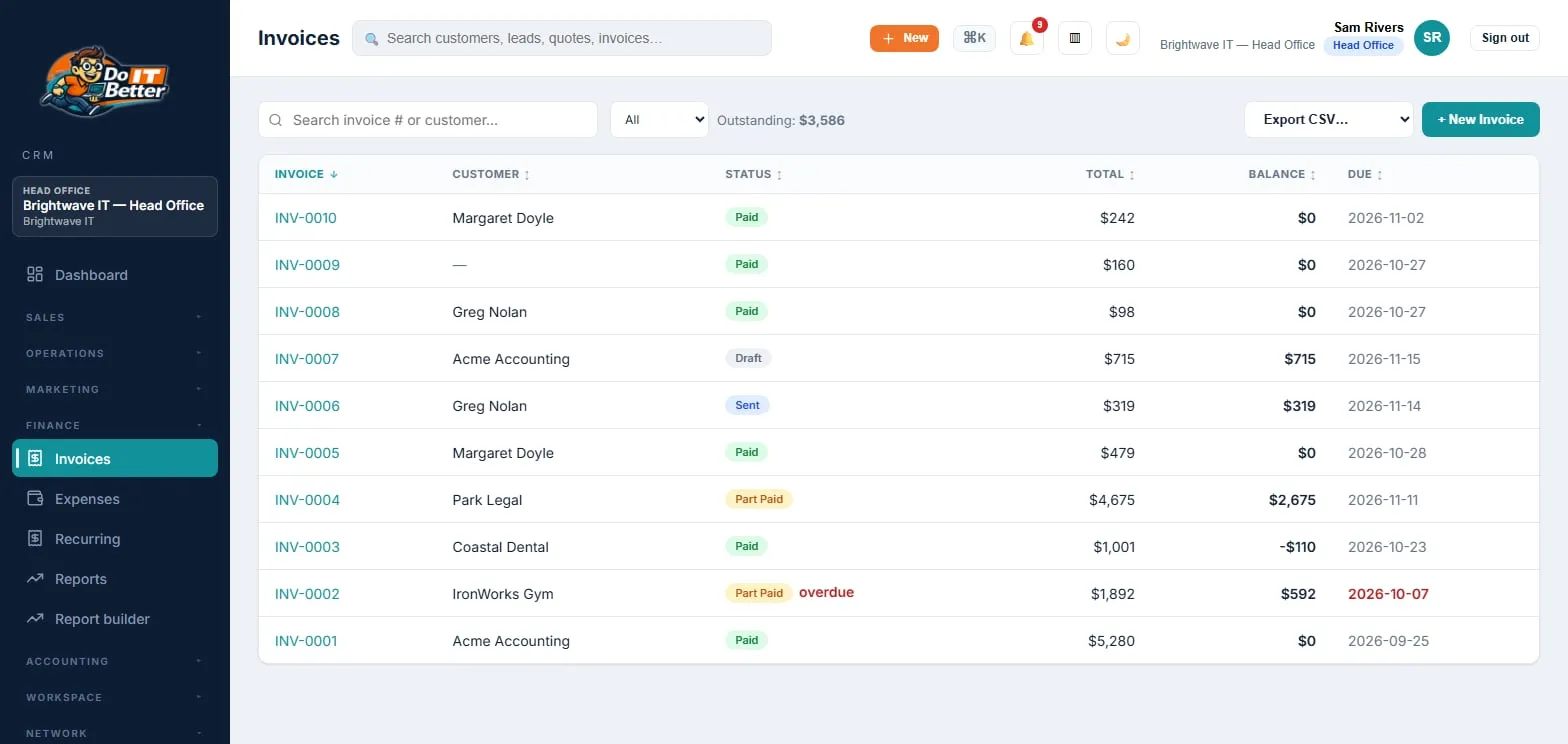
Invoicing
Paid, part-paid and overdue at a glance, with the outstanding total always in view.
-
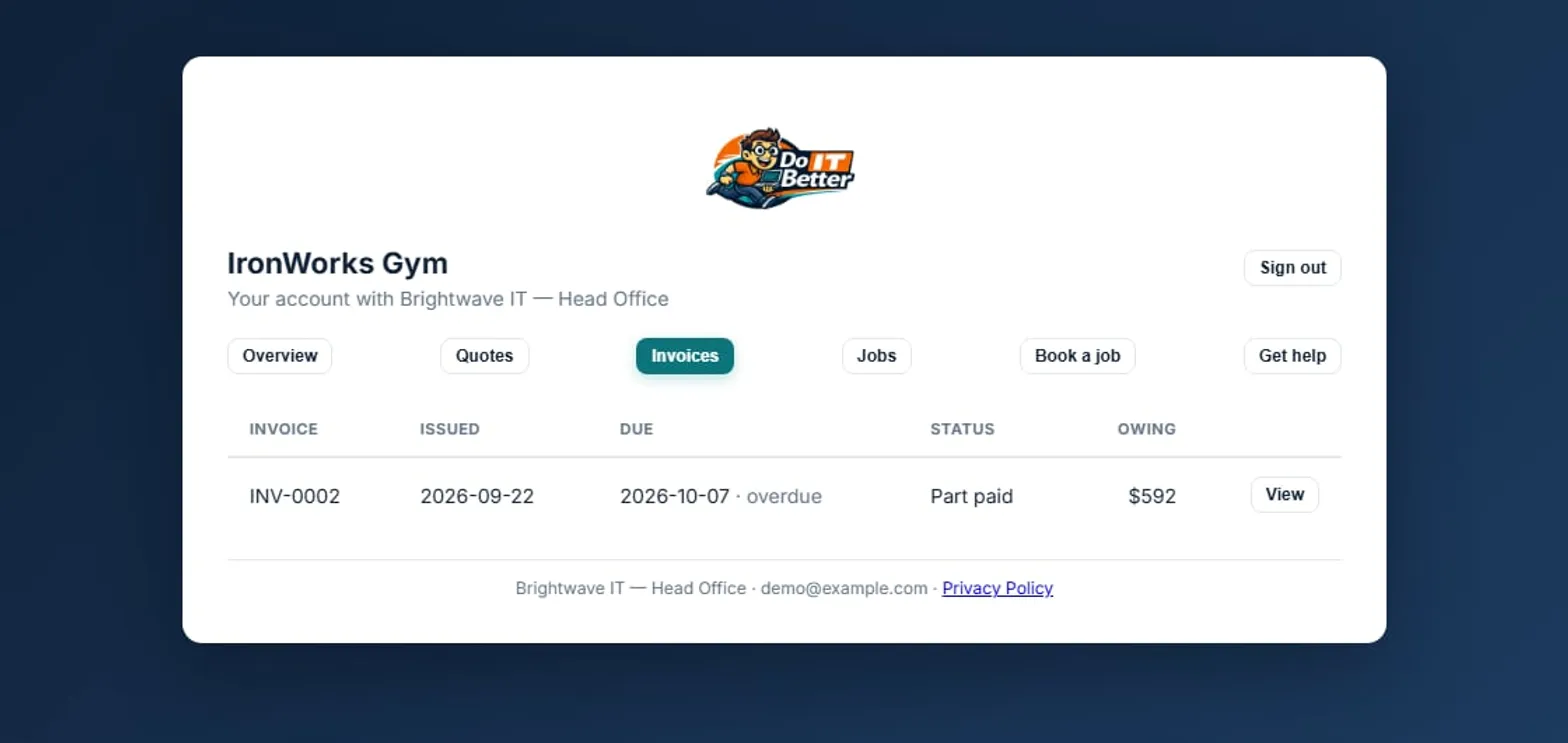
Customer portal
What the client sees: their quotes, invoices and jobs, with no password to remember.
What's inside
One system, every part of the business
No stitched-together apps — the whole operation in one place, role-aware for each person.
- CRM & Leads Contacts, communications, lead capture
- Pipeline & Reports Track the deal, date-ranged analytics
- Quoting Send, accept, convert to a job
- Jobs & Scheduling Operations with a calendar
- Point of Sale Register sessions, refunds, receipts
- Invoicing & Payments GST calculated per line, tax-invoice layout, credit notes
- Inventory & Purchasing Stock, suppliers, purchase orders
- Franchises & Territories Postcode routing, royalties, compliance
- Customer Portal Clients review & accept quotes online
- Integrations Xero & MYOB export files; payments and calendar sync to come
- AI Assistant Built-in help across the platform
- Audit & Roles 8 roles, every change logged
The technology
A conventional stack, chosen to last
Nothing exotic. Every choice here was made by asking who maintains this in five years, rather than what is newest.
-
Relational database
The business modelled as related records, not documents in folders.
-
Typed application layer
The rules live in one place, and the compiler catches a whole class of mistakes before anyone sees them.
-
Browser front end
No install, no per-device setup — it works on the laptop, the tablet and the phone in the van.
-
Role-based access
Eight roles, checked on the server rather than only hidden in the interface.
-
Change log
Changes to quotes, invoices, customers and accounts are recorded — who, what and when.
-
Integrations
Invoices and credit notes export in Xero and MYOB import formats. Direct Xero/MYOB sync, Stripe card payments and calendar sync are not switched on yet.
-
Franchise-scoped
Each franchise's data is kept separate on the server, not just hidden in the interface.
-
Changes are logged
Changes to quotes, invoices, customers and accounts are recorded — who, what, and when.
-
GST handled
GST calculated per line, a tax-invoice layout for GST-registered businesses, credit notes, and Xero/MYOB export files.
-
Cloud-ready
Local-first today, portable to a hosted database when it scales.
What it changes
What having one system actually buys you
-
The customer is entered once
One record, referenced by the quote, the job and the invoice — so a corrected phone number is corrected everywhere.
-
The outstanding total is a fact
It is read from the invoices, not reconstructed at the end of the month from three different exports.
-
A new territory is configuration
Franchise scoping was designed in rather than bolted on, so adding one is a setting — not a migration.
-
It outlasts whoever set it up
The audit log is the institutional memory. Handover does not depend on one person remembering the arrangement.
Deliberately no percentages or hours-saved figures: those have not been measured, and inventing them would undo the point of the page. What is above are properties of how the system is built — every one of them checkable against the screens further up.
Who it's for
Three ways this platform works
-
Built to run our own business
Do It Better's own work is moving onto it — lead to customer to quote to job to invoice to payment, all in one place.
-
Built for franchising
Franchisees see only their own data; head office sees the whole network. Territories, royalties and compliance built in.
-
Or built for your business
Want something like this for your own operation? We build and tailor business systems — start small, built properly.
Explore business systems →
Questions
The honest answers
Is this a product I can buy?
Not off the shelf today. It's our own operating system, built for how we run, and it's the proof behind what we build for other people. If you want something like it, we build and tailor business systems. That starts as a conversation, and what you'd own and what would be licensed is agreed in writing for each project. Using this platform's design or code for a client isn't automatic either; it's part of the same agreement.
Did a client commission this?
No, and we'd rather say so plainly. This is a Do It Better I.T. product — an internal build, not client work presented as a case study. Credibility should come from real capability, not from implying someone else paid for it.
Can I see it working?
Yes — request a demo and we'll walk you through the parts relevant to your business. The screens on this page are real captures from the platform, running on sample data, so no real client's information is shown.
Could you build something like this for us?
That's the usual reason people ask. It almost never starts at this size, though — most builds begin with the one process that's costing you the most time, and grow from there.
What is it built with?
A conventional, boring-on-purpose stack: a relational database, a typed application layer and a browser front end, with role-based access and a change log. Nothing exotic, because someone has to maintain it for years.
See it in action
Need something similar for your business?
Start a conversation. Most builds start with the one process costing you the most time, not with something this size.
